
Labyrinth Psychiatry Group · Published · FDA records and studies read that day · Clinical review by Dr. Salvatore G. Savatta pending
The short answer
One TMS-based system is FDA-cleared for PTSD. On June 3, 2026, the FDA cleared Wave Neuroscience’s MeRT System as an add-on treatment for adults with PTSD. The standard TMS used for depression, the kind tested in most PTSD research, is not cleared for PTSD, so using it for PTSD is off-label. The research on standard TMS is promising but mixed. A 2026 VA study of 756 veterans with PTSD and depression found that about half reached PTSD remission. A 2024 Cochrane review of 13 trials that compared real TMS with a fake (sham) treatment found it probably made little to no difference right after treatment. The largest results come from people who had PTSD and depression and received TMS for the depression.
What TMS is, in one paragraph
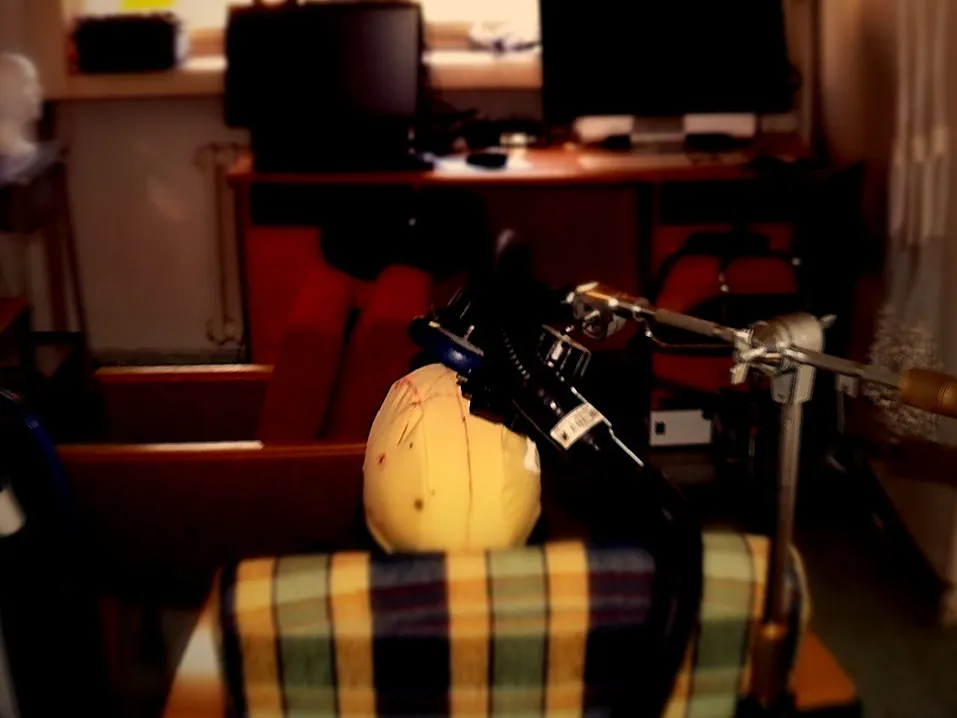
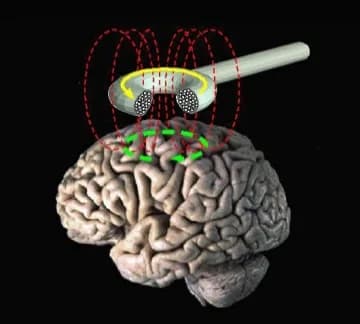
Transcranial magnetic stimulation (TMS) uses a magnetic coil held against the head. The coil sends quick magnetic pulses through the scalp and skull. They create a small electrical current in the brain tissue underneath. You stay awake in a chair, nothing is implanted, and no anesthesia is used. For depression, a course usually means a session five days a week for several weeks.
What the FDA has cleared TMS for
The FDA clears each TMS device for specific uses, listed on its record. These are the main ones, read from the FDA’s own records:
| Year | Cleared use | FDA record |
|---|---|---|
| 2008 | Major depressive disorder in adults whose depression did not improve with an antidepressant | K083538 (NeuroStar) |
| 2013 | Pain from certain migraine headaches | FDA 2018 announcement |
| 2018 | Obsessive-compulsive disorder in adults, added to other OCD treatment | DEN170078 (BrainsWay) |
| 2020 | An aid to short-term smoking cessation in adults | K200957 (BrainsWay) |
| 2021 | Depression with anxiety symptoms, when antidepressants have not helped enough | K210201 (BrainsWay) |
| 2026 | Add-on treatment for adults with PTSD, with the MeRT System, which sets the pulse rate from a brain-wave (EEG) recording | K260402 (Wave Neuroscience) |
The 2026 PTSD clearance: the MeRT System
The FDA’s summary for K260402 describes how the MeRT System works and what was tested:
- How it works. Software analyzes a resting, eyes-closed brain-wave and heart recording (EEG/ECG) and picks a personal pulse rate between 8 and 13 Hz. A compatible TMS device then delivers it to the front-middle of the brain (the dorsomedial prefrontal cortex). The software itself does not give any stimulation.
- The course. 20 to 25 sessions, one a day, five days a week, about 30 minutes each.
- The trial. 158 adults with PTSD were assigned to real treatment (77) or sham (81), and 84% finished. The real-treatment group improved significantly more than sham on both the self-rated PCL-5 and the clinician-rated CAPS-5. The real-treatment group’s PCL-5 score fell 27 points on average. No serious side effects were reported.
- Its limits. The trial was not designed to show whether the personal, EEG-based pulse rate matters compared with TMS at a fixed rate. The results above come from the FDA summary.
- Add-on only. It is cleared to be used alongside other PTSD treatment, not instead of it.
The clearance covers the MeRT System. It does not cover the standard depression settings used in the VA study and the Cochrane trials below. The FDA’s guidance for depression TMS devices still tells makers to warn that safety and effectiveness have not been established in people with a history of PTSD. That is a caution, not a ban. Labyrinth’s TMS page does not list MeRT, and this article does not suggest that Labyrinth offers it.
Two other PTSD-related devices turned up in the same FDA database search. Neither is TMS. Modius Spero (Neurovalens, May 2026) is a home-use headset that applies electrical stimulation for PTSD-associated symptoms. NightWare (2020) is an Apple Watch therapy that reduces sleep disturbance from nightmares, including PTSD nightmares.
What “off-label” means for standard TMS
- Some clinicians already use it. The 2026 VA study notes that TMS is increasingly used off-label for PTSD, often with settings developed for depression.
- The evidence is thinner. The 2024 Cochrane review found the sham-controlled PTSD trials so far small and inconsistent.
- Insurance usually will not pay for PTSD alone. See the insurance section below.
What the research shows
Two large summaries point in different directions. Here is each one, plainly.
The VA study of 756 veterans (2026)
Researchers at VA hospitals in Providence and Palo Alto looked at the records of 756 veterans with both PTSD and depression who had TMS for their depression at several VA sites. They compared the three most common ways of giving TMS, shown in the table (658 of the 756 veterans). PTSD symptoms dropped by 18 to 22 points on the PCL-5, a standard PTSD checklist. The VA’s summary calls it the first study large enough to show statistically significant benefits for all three methods.
| TMS method | Veterans | Response | Remission |
|---|---|---|---|
| 10 Hz TMS, left front of the brain | 526 | 63% | 47% |
| Intermittent theta burst (iTBS), left front of the brain | 71 | 65% | 48% |
| Deep TMS (dTMS) | 61 | 78% | 49% |
“Response” means the PTSD checklist score fell by more than 10 points. “Remission” means it ended below 33. The limits matter. Every veteran also had depression. There was no sham group, so nobody knows how much of the change came from TMS itself.
The Cochrane review of 13 trials (2024)
Cochrane reviews pool randomized trials. The 2024 review included 13 trials with 577 people, each comparing real TMS with sham TMS. Its main finding: real TMS probably makes little to no difference to PTSD severity right after treatment (moderate-certainty evidence, from the 3 trials with usable data, 99 people). When more trials were added, results varied widely from study to study. Serious side effects were rare, under 1% in both groups. None of the included trials reported remission right after treatment, so the review could not judge it.
This matters because many people searching this topic land first on a 2022 Cochrane page. That page is only the protocol, the plan for this review, with no results. The 2024 review is the finished version.
Smaller trials worth knowing
- Theta burst, 50 veterans (2019). In a sham-controlled trial at the Providence VA, 10 daily sessions improved social and work functioning at two weeks. Self-reported PTSD symptoms improved too, but not by a statistically significant margin. At one month, after up to 10 more open-label sessions, PTSD symptoms were significantly better than with sham.
- Slow versus fast TMS, 44 veterans enrolled (2019). A randomized trial gave 1 Hz or 10 Hz TMS five days a week for six weeks, then a three-week taper. Both groups improved on PTSD and depression scores. Neither speed beat the other.
- Earlier reviews. A 2022 review called the results “conflicting” and the sample sizes small, and called TMS relatively safe overall.
Why the results do not agree
- Different settings. Studies stimulated the left or the right front of the brain, at slow (1 Hz) or fast (10 Hz and faster, or theta burst) rates.
- Different amounts. Courses ran from 10 sessions to six weeks of daily sessions plus a taper, and some trials added therapy or trauma reminders.
- Different people. Many trials enrolled mostly male veterans or mostly female civilians, and the share with depression varied a lot.
- Different designs. The large VA study had no sham group, so some of the improvement may come from other care or from time.
What the VA’s treatment guideline says
The 2023 VA/DoD guideline for PTSD lists repetitive TMS among treatments with insufficient evidence to recommend for or against. Among medicines, it recommends paroxetine, sertraline or venlafaxine. The 2026 VA study came out after that guideline.
How TMS might act on PTSD
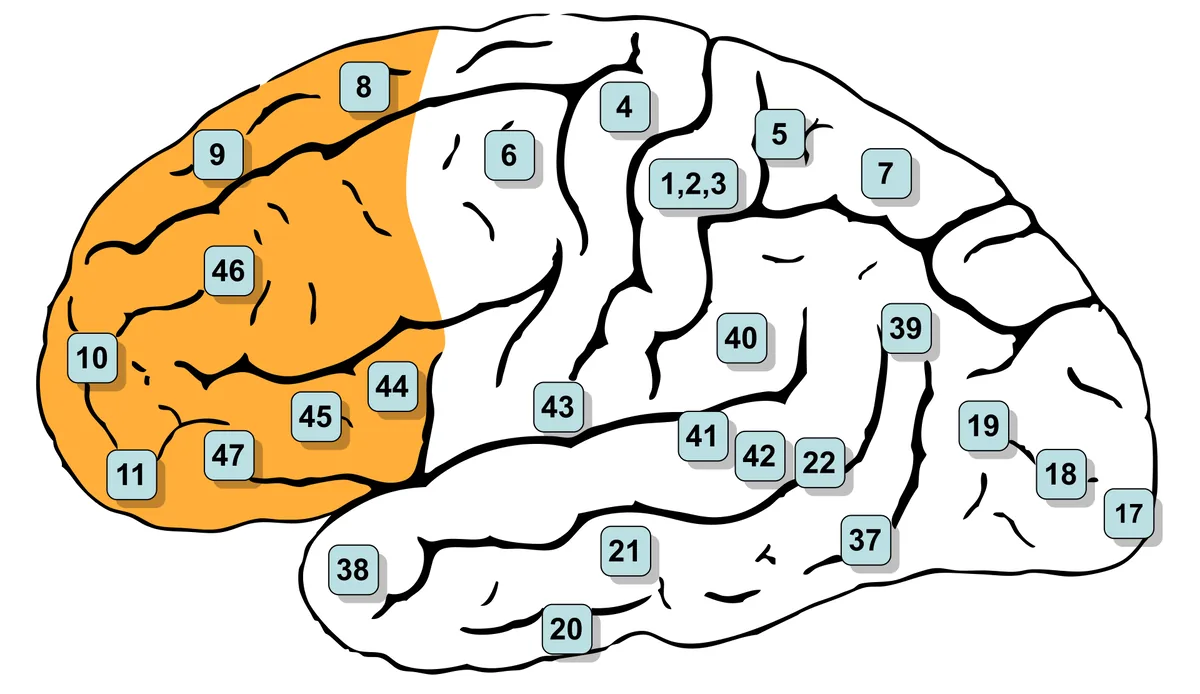
PTSD is linked to changes in three brain networks, according to the 2022 review. One of them, the executive control network, includes the dorsolateral prefrontal cortex at the front of the brain. That is where TMS is most often aimed. The same review reports that fast (high-frequency) stimulation has done better on PTSD rating scales than slow stimulation in studies so far.
One theory, set out in the Cochrane review plan: PTSD involves an overactive threat-detection system and weak “fear extinction,” the learning that a reminder is no longer dangerous. Stimulation may boost under-active brain regions or quiet over-active ones. The same authors say this simple picture is probably too simple. It is still being tested.
TMS for complex PTSD (C-PTSD)
Complex PTSD means PTSD plus lasting trouble with emotions, self-image and relationships. The VA’s National Center for PTSD explains its history:
- It was first proposed for people who went through long, repeated trauma, such as childhood abuse.
- It is a diagnosis in the World Health Organization’s ICD-11, which defines it by symptoms, not by the type of trauma.
- It is not a separate diagnosis in the DSM-5. There, many of its symptoms are part of PTSD itself.
Research on TMS for complex PTSD is very thin. The only study found for this article was a 2024 conference abstract from a private TMS clinic group. It reviewed the charts of 31 patients, 21 of whom met complex PTSD criteria. Trauma symptom scores fell 45% on average across all 31, with no comparison group. That is a starting point, not proof. If you have complex PTSD, ask your psychiatrist how the proven PTSD treatments apply to you, and treat TMS as an open question.
Where TMS fits next to proven PTSD treatments
The National Center for PTSD says PTSD treatment works, and names the options with the most support:
- Trauma-focused talk therapy: Cognitive Processing Therapy (CPT), Eye Movement Desensitization and Reprocessing (EMDR) and Prolonged Exposure (PE), usually 8 to 16 sessions.
- Medication: paroxetine, sertraline and venlafaxine have the most evidence.
TMS is not a replacement for these. Even the FDA-cleared MeRT System is cleared only as an add-on. In research it has been tried alone and alongside therapy. One trial paired weekly TMS with Cognitive Processing Therapy and found real TMS beat sham, as summarized in the 2026 study. A standard TMS session, as Labyrinth’s TMS page describes it, is time in a chair with the coil in place. It does not involve talking through the trauma, although some PTSD studies deliberately added trauma reminders.
Who might reasonably ask about TMS
- People with PTSD and depression, when the depression has not improved on an antidepressant. TMS is FDA-cleared for that depression, and the large VA study was in people with both.
- People who could not tolerate antidepressant side effects.
- People who have tried trauma-focused therapy and still have symptoms, as a conversation with their psychiatrist, including whether the FDA-cleared MeRT System is a fit.
Who usually cannot have TMS
Labyrinth’s TMS page lists the usual safety exclusions: a seizure disorder, metal or electronic devices in or near the head (such as aneurysm clips, cochlear implants or deep brain stimulators), implanted heart devices close to the coil, head tattoos made with metallic ink, and certain neurological conditions. The FDA’s 2018 OCD announcement also lists bullet fragments among the metal objects in or near the head that rule out that device.
Insurance and cost in New Jersey
Plans pay for TMS when it treats major depression and their criteria are met. For PTSD alone, coverage is unlikely:
- Aetna, one of the plans Labyrinth lists, names PTSD among the uses for which it considers TMS experimental, investigational or unproven (Clinical Policy Bulletin 0469, last reviewed July 17, 2026).
- The same Aetna policy also lists MeRT for PTSD as experimental, even though the policy was last reviewed after the June 2026 FDA clearance.
- The same policy covers TMS for severe major depression after set medication trials, up to 30 sessions plus 6 tapering sessions.
- With PTSD and depression, approval depends on the depression meeting your plan’s rules.
For the numbers, read how much TMS therapy costs in New Jersey and whether TMS is covered by health insurance.
PTSD care and TMS at Labyrinth in Cranford
Labyrinth Psychiatry Group’s PTSD care page describes an evaluation that moves at your pace. Visitors are not asked to share trauma details on the website. Treatment plans may include psychotherapy, cognitive behavioral therapy, exposure therapy and prescription medication. The office is at 11 Commerce Drive, Lobby Floor, Cranford, in Union County.
Labyrinth’s TMS page lists TMS for depression that medication has not relieved, and for OCD, at its Cranford and Edison offices. The page does not mention MeRT. This article does not say Labyrinth offers TMS, or MeRT, for PTSD on its own. If you have PTSD and depression, ask during your evaluation whether TMS fits your plan. The psychiatrist decides, based on your diagnosis, what you have tried and your safety history.
Questions to bring to the evaluation
- Is my PTSD the main problem, or is depression part of the picture too?
- Have I had a full course of a trauma-focused therapy (CPT, PE or EMDR) or one of the recommended medicines?
- Would TMS be for my depression, which standard TMS is cleared for, or for PTSD, where only the MeRT System is cleared?
- Does anything rule TMS out for me: a seizure history, metal or devices in or near my head, a head injury?
- What will my plan cover, and what would I pay if it does not?
- How will we measure whether it is working, and when do we decide?
Call 908-336-1187 or use the evaluation request form. Please do not include trauma details in the online form. Office staff follow up to arrange a time.
Questions about TMS for PTSD
Is TMS FDA-approved for PTSD?
One TMS-based system is. On June 3, 2026, the FDA cleared Wave Neuroscience’s MeRT System (510(k) K260402) as an add-on treatment for adults with PTSD, based on a sham-controlled trial of 158 people. Standard depression TMS, the kind used in most PTSD studies, is cleared for depression, OCD, smoking cessation and migraine pain, not PTSD, so using it for PTSD is off-label. A doctor can still recommend it, but the evidence and insurance rules differ from depression.
Does TMS work for PTSD?
The evidence is mixed. In a 2026 VA study of 756 veterans with PTSD and depression, 63% to 78% had a drop of more than 10 points on a standard PTSD checklist and 47% to 49% reached remission, but there was no sham group. A 2024 Cochrane review of 13 sham-controlled trials (577 people) found that TMS probably makes little to no difference to PTSD severity right after treatment, while noting large differences between studies. The 2023 VA/DoD guideline says the evidence is not enough to recommend for or against it. Separately, the 158-person trial behind the 2026 FDA clearance of the MeRT System found a statistically significant improvement over sham, according to the FDA summary.
Does TMS work for complex PTSD?
There is very little research. Complex PTSD is a diagnosis in the World Health Organization’s ICD-11, not in the DSM-5 used in most US practices. The only study found for this article was a 2024 conference abstract from a private TMS clinic group: a chart review of 31 patients, 21 of whom met complex PTSD criteria, with no comparison group. That is not enough to say whether TMS helps complex PTSD.
How many TMS sessions are used for PTSD?
It varies by study. In one VA trial, veterans had 10 daily theta-burst sessions and could add 10 more. Another VA trial gave sessions 5 days a week for 6 weeks, then a 3-week taper. The large 2026 VA study used the same courses clinics use for depression. The FDA-cleared MeRT System uses 20 to 25 sessions, one a day, five days a week. Labyrinth’s TMS page describes 36 sessions for depression, five days a week, over about six to eight weeks.
Is TMS for PTSD covered by insurance?
Usually not for PTSD alone. Aetna, one of the plans Labyrinth lists, names PTSD among the uses for which it considers TMS experimental, investigational or unproven (policy 0469, last reviewed July 17, 2026). The same policy also lists MeRT for PTSD as experimental. Plans that cover TMS generally do so for major depression when their criteria are met. If you have PTSD and depression, coverage depends on the depression meeting your plan’s rules.
Is TMS better than EMDR for PTSD?
No study has shown that. No head-to-head trial was found for this article. EMDR is one of the three talk therapies the VA’s National Center for PTSD lists as working best, with Cognitive Processing Therapy and Prolonged Exposure. TMS for PTSD is still being studied.
What is transcranial magnetic stimulation used for?
In the US, TMS devices are cleared for major depression, depression with anxiety symptoms, obsessive-compulsive disorder, short-term smoking cessation and pain from certain migraines. Since June 2026, one TMS-based system, the MeRT System, is also cleared as an add-on treatment for adults with PTSD. Researchers are studying TMS for other conditions.
Where can I find support for PTSD?
The VA’s National Center for PTSD has free education, a treatment decision aid and self-help tools. Veterans and their families can reach the Veterans Crisis Line by dialing 988 and pressing 1, or texting 838255. Anyone in crisis can call or text 988. For an evaluation in Union County, call Labyrinth Psychiatry Group at 908-336-1187 or send a request online.